

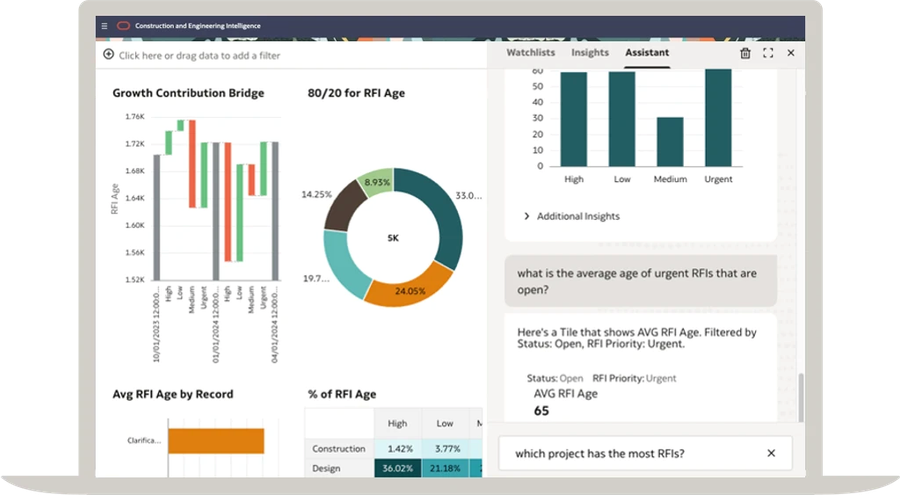
Last week, Oracle announced the general availability of its Construction and Engineering Advisor for Safety. An AI-Enabled predictive solution that can analyses historical project data, environmental conditions, and workforce patterns to predict which construction sites are most likely to have safety incidents. Not after they happen. Before, Oracle AI governance.
Through Construction Safety Management with AI tool, construction firms can better forecast the safety of project sites. The system generates weekly risk forecasts, identifies the top 20% of projects likely to account for 80% of incidents, and recommends targeted corrective actions. More supervision here. Better barriers there. Adjust the schedule to avoid that dangerous overlap of trades.
For an industry where someone is seriously injured or killed on site every single working day, this feels like progress. And it is.
But it also raises a question that very few people in the built environment are asking yet: who governs the AI that is supposed to keep people safe during working?
The Numbers That Matter
Construction remains one of the most dangerous industries in the world. In the UK, the Health and Safety Executive reported 51 fatal injuries to workers in 2023/24. Globally, the International Labour Organization estimates that construction accounts for roughly 30% of all workplace fatalities.
AI-monitored sites are showing real results. Independent studies cited by industry researchers suggest incident reductions of 40–60% compared to traditionally monitored sites. One major infrastructure project in Dubai reported zero lost-time injuries over eight months after deploying AI safety monitoring tools on project sites, down from 12 incidents in the prior comparable period.
These are not trivial gains. They represent real people who went home at the end of their shift because an algorithm spotted something a human could not.
But Here Is the Governance Gap
Predictive safety tools work by ingesting enormous volumes of data: past incident reports, weather patterns, crew compositions, equipment logs, schedule overlaps, even fatigue indicators. So, the Construction Safety Management tools make probabilistic judgments about risk, that is very important.
Now let we discus on some important aspects, what data is the model trained on? Whose incident history? If the training data comes primarily from large US contractors, how well does it predict risk on a residential refurbishment in Birmingham?
Who reviews the AI’s recommendations before they are acted on? If the system says a project is low-risk and the site manager relaxes oversight accordingly, who carries the liability if something goes wrong?
And what happens when the AI gets it wrong? Because it will. Every predictive model has a false-negative rate. The question is whether your firm has a governance framework that accounts for that.
“AI will not replace people but will supercharge the project team by simplifying workflows, reducing human errors, and transforming them into data-augmented decision makers.”
Singapore Is Already Ahead
While much of the industry is still figuring out basic AI policies, Singapore launched the world’s first governance framework for agentic AI at the World Economic Forum in January 2026. It covers autonomous AI systems that can plan, reason, and act. The kind of AI that Oracle’s safety predictor represents.
The framework requires clear permission boundaries, meaningful human oversight, and technical controls across the entire lifecycle. It is exactly the kind of thinking the built environment needs to adopt, not just for safety tools, but for every AI system touching a construction project.
The Takeaway
AI-powered safety prediction or AI That Predicts Construction Accidents are genuine breakthrough for construction firms. Oracle’s new tool, alongside offerings from firms like Firmus, Certain AI, and dozens of startups, is going to save lives. That is not in question.
An important question is whether the firms deploying these tools have the governance maturity to use them responsibly. Because an AI system that predicts safety risk is only as trustworthy as the framework around it. And right now, for most firms in the built environment, that framework does not exist.
The Responsible with AI programme helps architects, designers, and other built environment professionals develop practical frameworks for integrating AI tools responsibly.


