

A quantity surveyor at a major UK contractor described recently how she now produces a first-pass cost plan in roughly a quarter of the time it used to take. The AI tool she uses reads the drawings, matches elements against a benchmark database, and flags anything unusual. She still checks every line. But the hours of manual takeoff are largely gone. That shift is already underway inside firms like Gleeds, Turner & Townsend, and Currie & Brown, and the pace is picking up.
If you are wondering what a quantity surveyor in 2026 is, the honest answer is: a professional whose core tasks are changing faster than at any point in recent memory. Measurement and bill preparation, the bedrock of the QS position for generations, are increasingly the areas AI handles first. Ask the same question in a different way: What is a quantity surveyor actually paid to do going forward, and the answer shifts from counting things to advising on them. The question is not whether to engage with this, but how to do it without losing the professional judgement that clients actually pay for.
What AI can already do inside a QS workflow
The tasks most exposed to AI are also the most time-consuming in a traditional quantity surveyor role. Automated takeoff tools can extract quantities from PDF and DWG drawings, classify elements, and export a structured bill of quantities. Research published in Construction Management and Economics in September 2025 found that an NLP-based ensemble system achieved 82.96% agreement with QS-based estimations and came within -2.05% total cost deviation. That is not perfect, but it is good enough to be a first draft that a competent surveyor reviews and corrects. The researchers were clear that the AI is designed to complement QS professionals, not replace them, acting as a notification tool that alerts practitioners to discrepancies.
Tender analysis is moving in the same direction. AI can compare returns across multiple packages, flag outliers, identify where a contractor has priced unusually low or missed items entirely, and produce a summary in minutes. RLB, in a September 2025 paper on the future of the quantity surveyor profession, acknowledged that AI is a "powerful enabler for comparison, analysis and generation of strategic recommendations." RLB also noted that LLMs still struggle with numbers but that models are "rapidly advancing toward integrated language and numerical reasoning capabilities, which will eventually automate traditional quantification tasks."
Cost planning is the third area seeing real change. Gleeds uses its proprietary OCE Calculator and its Orchestrate platform, with clients reporting up to 60% faster collection and reporting of portfolio data and a 30% improvement in budget reporting accuracy. Turner & Townsend's Hive platform processes millions of data points daily, benchmarking live performance against comparable projects, enabling 50% faster decision-making according to the firm. Both platforms represent a shift from the QS as a manual data gatherer to an analyst who interrogates a system that does the heavy data lifting.
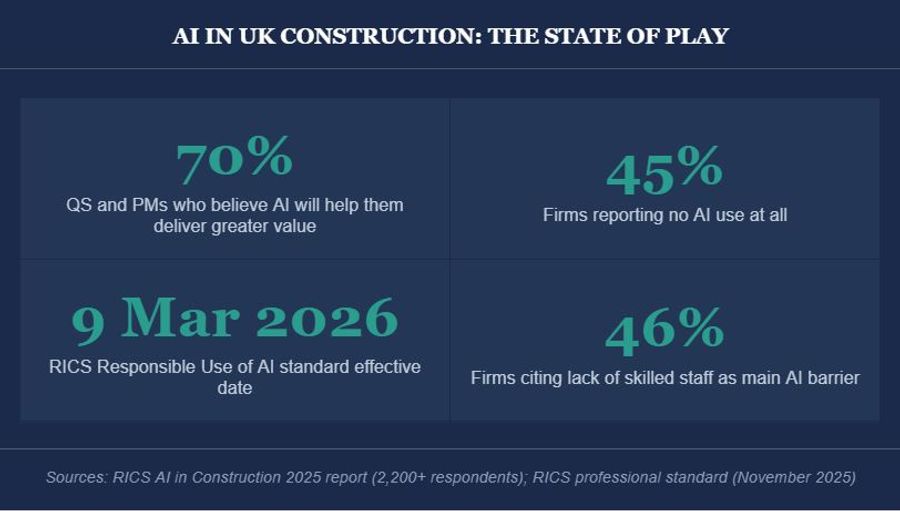
None of this makes the role redundant. The RICS AI in Construction 2025 report, drawing on more than 2,200 responses worldwide, found nearly 70% of project managers and QS professionals believe AI will help them deliver greater value. But only 1% of firms have scaled AI across projects. Anil Sawhney, Head of Sustainability at RICS, said the sector was "at a tipping point" and that tangible progress requires "high-quality data, compelling value propositions, organisational readiness and strong leadership to champion the responsible use of AI."
What the RICS standard means for your practice
From 9 March 2026, the RICS Responsible Use of Artificial Intelligence in Surveying Practice standard is mandatory for every RICS member and regulated firm using AI in a way that has a material impact on the delivery of surveying services. For a quantity surveyor, material impact means AI outputs capable of influencing how the service is delivered. A cost plan produced with AI assistance would almost certainly qualify. So would a tender analysis summary that a partner relies on to advise a client. The full standard is available on the RICS website.
The standard sets specific obligations. Firms must maintain an AI risk register, reviewed quarterly. They must have a responsible use policy. They must assess whether an AI system is fit for purpose before deploying it. They must disclose AI use to clients in the terms of engagement. And when a quantity surveyor uses AI in a way that materially affects the work, they must record in writing the key assumptions made, any concerns about reliability, and whether the output is fit for its intended purpose. The record must be prepared under the supervision of a qualified surveyor.
This matters because AI outputs can be biased, incomplete, or simply wrong. The RICS standard explicitly references hallucinations, where AI generates false or invented output, as both a limitation and a potential failure mode. For a quantity surveyor, an AI-generated quantity that is 10% out on a major building package is not a curiosity. It is a professional liability issue. The standard is designed to ensure the professional, not the algorithm, remains accountable. The EU AI Act, now in force, reinforces this direction of travel at the legislative level.
"The aim is to put the profession on a more secure footing through upskilling and positive engagement with the technology, developing awareness and real understanding of why AI is being used within firm processes and how the technology is integrated in the delivery of services." RICS spokesperson, RICS Construction Journal, March 2026
Training, routes in, and what the QS position looks like now
AI-assisted cost planning software: the new baseline tool for cost planning and budget reporting.
How to become a quantity surveyor is a question with a slightly different answer now than it had five years ago. The technical foundations have not changed: measurement, procurement, contract administration, and cost management. But the digital layer is thicker. RICS apprenticeship routes into the quantity surveyor role sit alongside degree pathways, and both are seeing increasing integration of digital and AI skills. The CITB has begun incorporating AI awareness into apprenticeship frameworks, though uptake among experienced practitioners remains limited, according to Helium42's 2026 analysis of AI adoption in QS practice.
If you are researching how to become a quantity surveyor today, the QS position you are entering will expect fluency in at least one AI-assisted takeoff or cost planning tool from day one. That does not mean being a software developer. It means understanding how AI-assisted measurement works, what its failure modes are, and how to validate the outputs. The RICS standard requires that all members using AI have awareness of different AI types, their limitations, and the risks of erroneous outputs. That is a baseline competence requirement, not an advanced specialism.
For firms, the training investment is real. A small practice of five surveyors should budget £3,000 to £8,000 in year one for training, with larger practices looking at £10,000 to £25,000, according to the Helium42 analysis. Software costs typically run £2,000 to £8,000 annually per user. Return on investment generally materialises within 12 to 18 months through time savings on measurement and estimation. For those asking how to become a quantity surveyor and build a sustainable career, the upskilling investment is not optional.
The advisory pivot: where the real value is
RLB put it plainly: the profession is "moving away from being technical 'numbers people'." As AI handles more quantification work, the competitive advantage for a chartered QS shifts toward strategic advice, contractual expertise, and client relationships. That means value engineering, lifecycle cost analysis, embodied carbon assessment, and procurement advice that requires understanding a client's risk appetite, not just their budget. The modern quantity surveyor, in RLB's framing, must "speak the language of engineers, planners, data scientists, and sustainability consultants."
Arcadis's Autumn 2025 UK Construction Market View and Mace's Q3 2025 UK Market View both showed tender price inflation running at 3.5-4.0% across most sectors, with labour costs and capacity pressures keeping prices elevated. Clients dealing with that environment are demanding more from their cost advisors, not less. The quantity surveyor who can give a credible view on where costs are heading, what procurement strategy minimises risk, and how to handle a variation claim under an NEC4 contract, is not going to be displaced by an algorithm. The quantity surveyor whose value lies mainly in producing bills manually is in a more vulnerable QS position.
Currie & Brown's 2026 global construction costs report framed the challenge well: firms that want to stay relevant need to "prioritise quality data, plan skills needs early, and use technology to improve productivity." That is a good description of what the best-run practices are actually doing. Gleeds, Turner & Townsend, RLB, Arcadis, Mace, and Currie & Brown are all, to varying degrees, investing in data platforms, AI tooling, and staff development. The firms that treat the RICS standard as a compliance burden rather than a professional framework will lag.
Three things to do now
One. Read the RICS standard. It is short, practical, and mandatory. If you are a quantity surveyor in a regulated firm, you need to understand what "material impact" means for your specific work and what your firm's responsible use policy says. If your firm does not have one yet, that is a gap to fix before a regulator asks.
Two. Try one AI tool on a real project. Measure an element by hand, then run the same job through an AI takeoff tool and compare the outputs. That exercise will teach you more about where the technology is reliable and where it needs oversight than any CPD course. Document what you find. That documentation is also what the RICS standard expects.
Three. Update your terms of engagement. If your firm uses AI in a way that has a material impact on the service you deliver, the RICS standard requires you to tell the client. Add a clear, plain-English disclosure. Clients generally respond well to transparency. They respond badly to discovering AI was used on their project without being told. This is also the moment to think about what is a quantity surveyor's accountability when an AI output turns out to be wrong: the answer, under the RICS standard, is that it remains yours.
The quantity surveyor role is not disappearing. It is getting harder to do badly and more interesting to do well.
The Responsible with AI programme helps architects, designers, and other built environment professionals develop practical frameworks for integrating AI tools responsibly.


