

Pull up the contract on any major UK construction project starting this year. It is almost certainly NEC4 or JCT 2024. Now search the document for the word "artificial" or the letters "AI". You will find neither. The two dominant UK construction contract families do not address AI in construction at all. Muckle LLP confirmed this in April 2025: the standard forms have not been reviewed by their publishers to confirm they are appropriate for projects where AI is in use. That gap is not theoretical. It is happening now, on live projects, with real money and real liability attached.
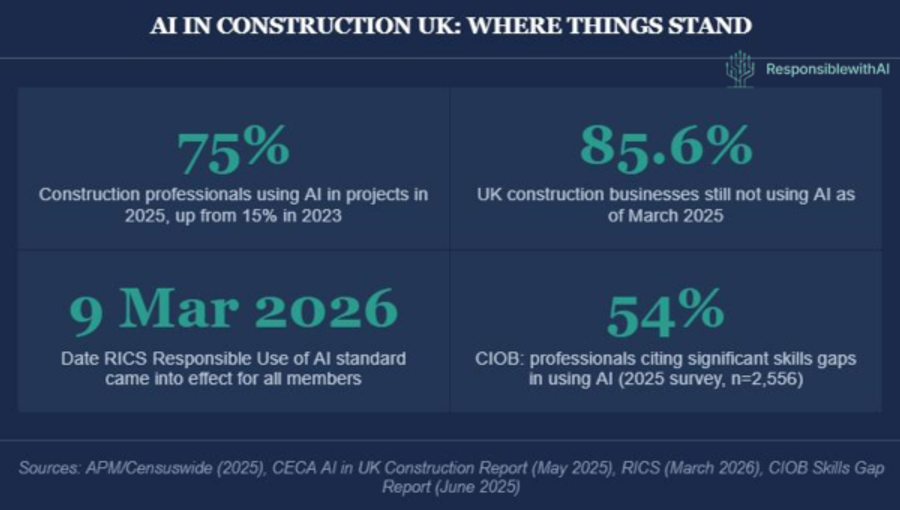
AI in construction has moved from pilot project to everyday tool faster than most people in the sector realise. According to the Association for Project Management, 75% of construction project professionals said their organisation was using AI in projects in 2025, up from just 15% in 2023. Two years earlier, 63% said their organisation had no plans to introduce AI at all. The adoption curve for AI in construction UK projects has been steep and largely ungoverned.
The CECA AI in UK Construction Report (May 2025) adds important texture to the picture of AI in construction adoption. As of March 2025, 85.6% of UK construction businesses reported they did not currently use AI, compared to almost 75% of businesses in other sectors. Construction is still the laggard on adoption, but that gap is closing fast. The same report describes AI already operating on UK sites: algorithms handling complex GIS data to inform design before projects reach site, bots processing social media to understand how roadworks affect users in real time, and cameras using AI to recognise and track plant movements. The tools are in, the governance is not.
The Contract Gap
NEC4 Core Clause 10.2 requires parties to act in a spirit of mutual trust and co-operation. JCT 2024 Article 3 requires cooperative and collaborative working. Both are written for human decision-makers. Neither makes any provision for AI-drafted Compensation Event narratives, AI-generated variation analyses, or AI-authored tender responses. This is the central legal exposure point in AI in construction practice today.
The problem surfaces in the detail. Under NEC4, when a Project Manager assesses a Compensation Event, the contract presumes the reasoning is human, professional, and defensible. If the narrative was drafted by an AI tool, the contract has no mechanism for disclosing that fact, no requirement to verify the reasoning, and no allocation of risk if the AI produced a plausible but incorrect analysis. Under JCT, the same logic applies to Relevant Events and variation claims. The reviewer signs it. Six months later, in adjudication, the question becomes whether the analysis represents the contractor's professional position or the tool's output. JCT 2024 has no clause that even acknowledges the question.
This is not hypothetical. CIOB's Skills Gap Report (June 2025), based on 2,556 respondents, found that 54% of construction professionals said there were significant skills gaps in using AI, and awareness of its practical applications was described as low. Concerns around accuracy, over-reliance, and potential deskilling were flagged repeatedly. People are using tools they do not fully understand to produce documents that sit inside contracts that do not address those tools. The gap between what AI in construction tools can produce and what professionals can verify is real and growing.
Building Safety Act: A New Layer of Exposure
The Building Safety Act 2022 adds a dimension that has not yet fully landed in the AI in construction conversation. The Act creates extended liability periods for defective buildings, up to 30 years for claims under the new regime, and establishes new duty holder roles across design, construction, and occupation. The question practitioners working in this sector need to ask is this: if an AI tool contributed to a design decision, a structural calculation, or a compliance assessment, and that decision later proves to be defective, who is the accountable duty holder?
The Building Safety Act's framework of Accountable Persons and Building Safety Managers assumes human professional accountability throughout. It makes no provision for AI-generated outputs that form part of the safety case. The standard of care question becomes acute: a contractor cannot argue that reasonable skill and care means something different when AI is involved, as Muckle LLP noted. The liability exposure does not diminish because the tool was used in good faith. If anything, the extended limitation periods under the Building Safety Act mean that AI-related defects in design or safety documentation could surface years after a project closes.
What the RICS Standard Actually Requires
The RICS Responsible Use of AI in Surveying Practice standard came into effect on 9 March 2026 for all RICS members and regulated firms. It is the first global professional standard of its kind for the built environment. If you are a chartered surveyor working in AI in construction UK contexts, this is now mandatory, not optional.
The standard sets out four areas of obligation: governance and risk management, professional judgement and oversight, transparency and client communication, and responsible development of AI. In practical terms, this means firms must maintain a written AI systems register, a risk register reviewed at least quarterly, and documented procurement due diligence on any third-party AI tool before use. Clients must be informed in writing in advance where AI is used on their matter and given the right to challenge or opt out. A named surveyor must take accountability for every piece of professional advice, regardless of whether AI in construction tools contributed to producing it.
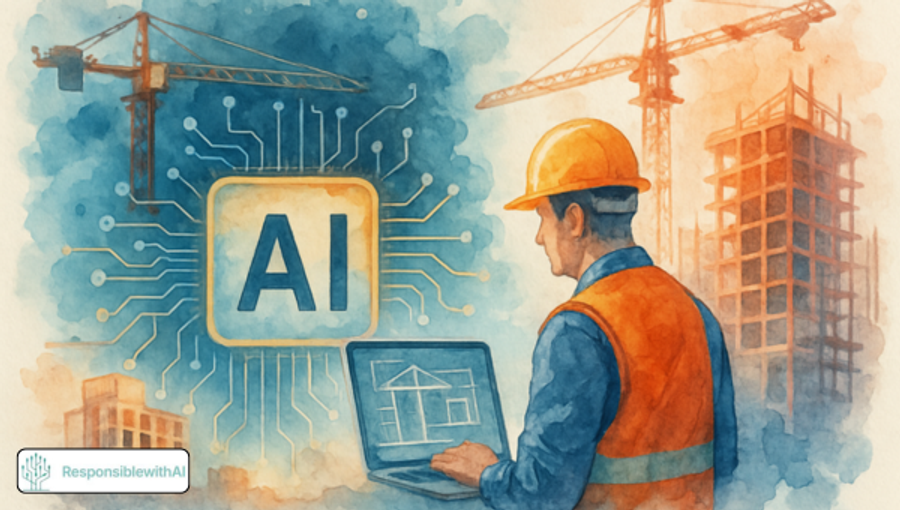
BIM and AI software tools are generating Compensation Event narratives, design options, and cost forecasts. The vendor terms behind these tools often cap liability at the subscription fee.
Paul Beeston FRICS, speaking at the RICS Westminster event in December 2025, put the stakes clearly:
"I do worry about automation bias. The view that it must be true because the computer says it's true. The standard helps here as it talks about professional scepticism. This highlights the importance of the Chartered Surveyor in curating the inputs and validating the outputs. The standard gives the profession the ability to demonstrate its worth to clients in an AI world." Paul Beeston FRICS, Chartered Surveyor, speaking at RICS (December 2025)
The Vendor Liability Cap Problem
There is one more layer that most project teams have not examined. Every AI tool in use on a UK construction project sits behind a vendor contract. Typically, that contract caps the vendor's liability at the annual subscription fee. If an AI tool drafts a Compensation Event narrative that misreads a clause, or generates a cost forecast that leads to a significant commercial loss, the vendor's exposure might be a few hundred pounds. The firm whose professional signed the output carries the rest. This is true across the full range of software products used in AI in construction practice, from scheduling tools to claims analysis platforms.
Muckle LLP's analysis makes this explicit: both parties to a building contract should assess AI risk against the overarching limitations of liability. The question of whether the AI-related risk should attract its own uncapped liability exposure is not academic. On large infrastructure projects, the asymmetry between vendor cap and project exposure is stark. The clickwrap terms behind most AI tools were not written with NEC4 Compensation Events in mind. They need to be read before the tools are deployed, not after a dispute arises.
Courses, Competence, and the Training Gap
The CIOB Skills Gap Report found an 83% combined skills gap across modern technology areas for construction professionals. That figure encompasses both AI and digital technologies. The profession is being asked to use tools it does not yet understand inside governance frameworks it has only recently been given. Good AI in construction courses are part of the answer, but take-up across the industry has been patchy.
AI in construction courses are now available from several credible providers. RICS and BCS jointly offer the BCS Foundation Certificate in the Ethical Build of AI, available to RICS members from £180 plus VAT, providing structured coverage of AI ethics in the built environment context. The Innovate UK BridgeAI programme delivered free AI in construction courses modules through early 2025, covering responsible AI, data fundamentals, and project management, specifically targeted at SME managers in the sector.
For firms subject to the RICS standard, the competence question is now a compliance question. The standard requires firms to ensure staff training covers not just how to use AI tools but how to understand their limitations, error risks, and bias risks. An AI ethics course focused on built environment contexts, such as the BCS Foundation Certificate, is a sensible starting point for QS and project management teams. The RICS itself hosted an AI training event for non-technical professionals at its London headquarters in May 2026, directly mapped to the new standard's obligations. Completing an AI ethics course creates an auditable record of competence development, useful evidence if a governance question ever arises.
The RICS AI in Construction Report (September 2025), drawing on responses from more than 2,200 professionals globally, with 48% of responses from the UK, found that 46% cited lack of skilled personnel as the main barrier to AI adoption, well ahead of regulatory uncertainty or cost. The training gap is real, and the industry knows it. What has changed since November 2025 is that the regulatory framework has also arrived. Practice in this area now sits inside a professional standards regime, whether or not all practitioners have noticed.
Three Things to Do Now
One. Add an AI clause to your standard contract amendments. Not a generic one. Write it around how AI is actually being used on your projects. Identify which party is responsible for verifying AI outputs, how AI use must be disclosed, and how liability is allocated when an AI-generated document contributes to a dispute. The firms writing these clauses now will not be the ones explaining their absence to an adjudicator. This applies equally under NEC4 and JCT: both are silent on AI use and both need bespoke amendments.
Two. Read the vendor terms behind every AI tool your team uses. Locate the liability cap. Then assess whether that cap is proportionate to the commercial decisions the tool is influencing. If the gap is significant, either negotiate, obtain project-specific insurance cover, or restrict the tool to tasks where the exposure is manageable.
Three. If you or your colleagues hold RICS membership, treat the Responsible Use of AI standard as the floor, not the ceiling. Build your AI systems register and risk register now if you have not already. If your team is using AI in construction UK contexts without documented governance, you are already non-compliant. An AI ethics course or the RICS-BCS Foundation Certificate is a practical way to close the competence gap and evidence it.
AI in construction is not arriving. It is already here, already shaping documents, already influencing decisions on live UK projects. The contracts, the competence, and the governance need to catch up. The window to do that proactively, before a dispute makes it retrospective, is right now.
The Responsible with AI programme helps architects, designers, and other built environment professionals develop practical frameworks for integrating AI tools responsibly.


