

Ask a vendor to demo their cafm software this year and within five minutes you will see AI mentioned. Ask them again which AI model powers their predictions, where training data comes from, and what happens when it gets a decision wrong, and most will start shuffling papers. That gap, between AI-as-marketing-headline and AI-as-auditable-system, is now the central problem for every FM director choosing cafm facility management software in 2026.
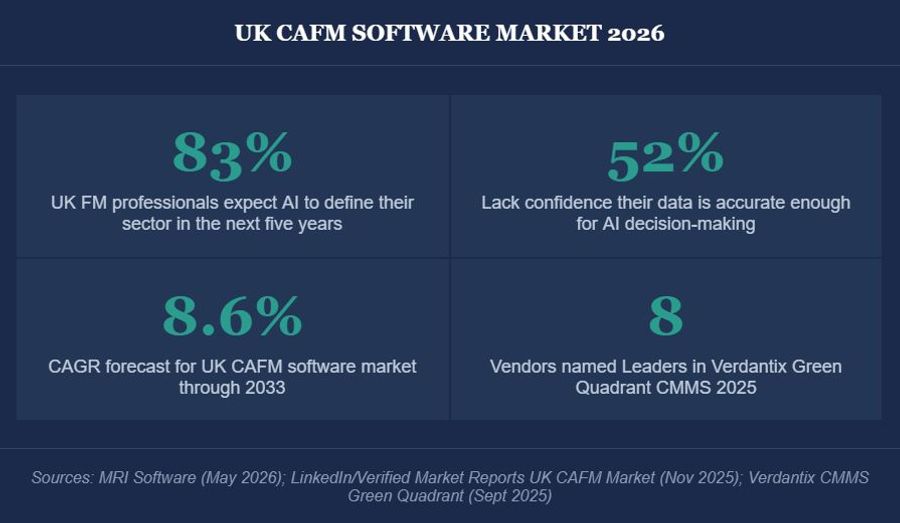
The market has consolidated fast. According to MRI Software research published in May 2026, 83% of UK FM professionals expect AI, automation and smart technologies to define the next five years of their profession. Yet 52% say they do not have confidence that their data is accurate enough to support AI-driven decision-making. That combination, broad optimism alongside weak data foundations, defines where the CAFM software market sits right now. For FM directors comparing the best CAFM software options available, the question is no longer which platform has AI, but which vendor can explain it.
What the main platforms are shipping in 2026
The UK CAFM software market has always had clear tiers. At the enterprise end, MRI Evolution (formerly Concept Evolution by FSI, now part of MRI Software) brings together hard and soft FM on a single platform, combining AI-powered predictive analytics, IoT integration, and automated helpdesk escalation. Its UK pedigree is strong, and it remains one of the most widely deployed pieces of CAFM software UK organisations use across NHS, local government, and commercial property. Planon, named a Leader in the Verdantix Green Quadrant for CMMS 2025, ships IoT-led automation, no-code workflows, predictive maintenance through integrations with Schneider Electric, and digital twin functionality for real-time asset tracking. For large multinational estates, it is one of the strongest contenders when evaluating best CAFM software options.
IBM TRIRIGA sits at the full IWMS end of the spectrum, adding GHG calculation and decarbonisation planning through IBM Envizi, lease accounting, and capital project management. It was also named a Leader by Verdantix in its 2025 Green Quadrant: CMMS analysis. Implementation cycles run to twelve to eighteen months, so it suits organisations with complex global portfolios rather than single-site UK operators. ServiceChannel, which in April 2026 launched ServiceChannel AI, the self-described AI operating system for FM, embeds intelligence across work order creation, triage, expediting and analytics. Its dataset of 300 million work orders gives its pattern-recognition models real weight, and it is designed for retail, hospitality, healthcare and multi-site operators. Archibus (now part of Eptura/IFS) remains deep on data-driven capital planning, asset analytics and space optimisation, and in March 2025 reportedly secured a contract with a European government agency to manage over 5,000 public buildings on a single platform.
Lower in the market but worth watching for UK public sector and healthcare contexts: Asckey's fmfirst is a modular CAFM facility management software suite with a strong NHS England customer base, offering scalable, compliance-focused tools that can be adopted incrementally. FaultFixers positions itself as a straightforward, mobile-first CAFM software UK SMEs and mid-market operators use to automate compliance records, maintenance scheduling and contractor management without enterprise complexity. Maintenance Connection (Accruent) brings IoT integration, multi-site analytics and AI-ready data pipelines to manufacturing and healthcare environments, while Smartsheet covers project and resource management functions that often overlay a core CAFM system. Workdyne and Service Insight serve the UK FM services market with mobile-first work order and contractor management tools that sit closer to CMMS territory than full IWMS.
AI features are converging, but quality varies sharply
Every major piece of CAFM software now ships at least three AI capabilities: predictive maintenance using equipment sensor and historical maintenance data to flag failures before they occur, occupancy and space optimization using booking, badge and sensor data to recommend layout changes, and anomaly detection on energy consumption. The surface-level feature lists have converged. What has not converged is the quality of underlying models, the provenance of training data, and the mechanisms for alerting users when the AI output should not be trusted.
ServiceChannel AI is explicit that its models draw on 300 million real work orders, which is a meaningful claim. Planon's predictive maintenance relies partly on third-party integrations rather than native AI models, which is honest and pragmatic but means the quality depends on the quality of the partnership. MRI Evolution describes AI-powered portfolio performance and predictive analytics as core features, though the depth of model documentation publicly available is limited. IBM TRIRIGA, underpinned by IBM's broader AI infrastructure, offers the most enterprise-grade audit trail but at a cost and complexity that prices out most UK mid-market operators.
The Verdantix 2025 Tech Roadmap for Real Estate and Facilities Software is blunt on one point: it classifies traditional CAFM as being in Phase 5 (Decline), while AI-powered digital assistants, agentic AI maintenance and connected portfolio intelligence platforms are in growth phases. That does not mean the category is dead. It means the platforms that do not embed AI credibly will lose relevance faster than their salespeople are telling them.

FM engineers using mobile-first CAFM software can log work, access AI alerts, and update asset records in real time without returning to a desk.
The responsible AI angle vendors are not talking about enough
Here is the problem buried in the 52% data-confidence figure. If your underlying asset records are incomplete, inconsistent or siloed, the AI sitting on top of them will produce confident-sounding wrong answers. In CAFM facility management software, that could mean a predictive maintenance alert that misses a critical failure because the asset history was never migrated from the old spreadsheet. Or an energy optimisation recommendation based on occupancy data that excludes half your floors because two BMS systems were never integrated properly. This is not a theoretical risk. It is the lived experience of FM teams who rushed AI adoption without first fixing their data foundations.
"AI is no longer a distant concept for facilities management; it's clearly on the radar. But the findings show that enthusiasm alone isn't enough. Reliable, connected data is the foundation that fuels AI's true potential. Without it, even the most advanced technology will struggle to deliver meaningful value." James Massey, Managing Director for Facilities, Energy Management and Retail Intelligence, MRI Software
The governance frameworks now exist to address this properly. ISO/IEC 42001:2023, the international standard for AI management systems, requires organisations to document AI risk assessments, conduct impact assessments on affected stakeholders, and establish continuous monitoring of model performance. For an FM director buying CAFM software with embedded AI, this standard provides a clear lens. You are not just a user of the AI. You are deploying it against your building occupants, maintenance engineers, and contractors. Under the EU AI Act, certain FM automation tools may qualify as higher-risk AI systems, particularly where they affect worker scheduling, access control or safety-critical asset management. Checking where your shortlisted CAFM software falls in that classification is now a procurement step, not an afterthought.
The IWFM's 2026 guidance on technology in workplace and facilities management reinforces this. FM directors are increasingly accountable for the decisions their systems make, not just the decisions they make personally. When CAFM software routes a reactive maintenance job to the wrong contractor because the AI mis-classified the trade, and an SLA is breached, the accountability question lands on the FM team, not the software vendor's algorithm.
The buying decision now includes an AI risk assessment
Choosing the best CAFM software in 2026 means adding a new strand to your evaluation scorecard. Beyond the standard questions on configurability, integration, mobile access, pricing and support, you need answers to at least four more questions.
First, what data does the AI actually train on, and is it yours? Some platforms use anonymised pooled datasets from all their customers. Others train exclusively on your own historical data. The difference matters for accuracy and for data governance under UK GDPR.
Second, how does the system signal low confidence? A prediction presented with the same visual weight whether it is 95% confident or 55% confident is more dangerous than no prediction at all. Good CAFM software should surface uncertainty, not hide it.
Third, is there a human override workflow? The best implementations of AI in CAFM software UK organisations are deploying AI recommendations as inputs to human decisions, not automatic triggers. If the system is auto-approving work orders, auto-selecting contractors, or auto-escalating safety incidents without a human confirmation step, you need to know that before you sign the contract.
Fourth, what is the vendor's position on ISO 42001 or equivalent? You do not need your CAFM software vendor to be certified today. But if they cannot tell you what their AI governance framework looks like, that is a signal about how seriously they are thinking about responsible deployment.
Three things to do now
One. If you are currently evaluating CAFM software, add an AI due diligence section to your RFP or vendor scorecard. Ask each vendor to describe their data sourcing, model confidence signals, human override mechanisms, and AI governance framework. Their answers will be revealing.
Two. Audit your data before you budget for AI features. MRI Software's research is clear: 56% of UK FM teams cite cost as the biggest barrier to technology investment, but the real constraint for many is data quality. A CAFM software implementation built on fragmented, incomplete or uncleaned asset records will not deliver on its AI promises, regardless of the vendor you choose. Treat data remediation as a prerequisite, not a follow-on project.
Three. Read the ISO 42001 standard summary and map it to your CAFM facility management software shortlist. Even a lightweight assessment covering AI risk identification, impact on FM staff and building occupants, and model oversight processes will put you ahead of most FM teams currently making these buying decisions. The standard is not onerous. It is a structured way to ask the right questions before you commit.
The CAFM software vendors that will still be market leaders in five years are the ones building their AI on solid governance foundations. The ones wrapping generic models in FM-flavoured marketing language will become visible for what they are as clients get better at asking the right questions. You can start asking those questions now.

The Responsible with AI programme helps architects, designers, and other built environment professionals develop practical frameworks for integrating AI tools responsibly.


