

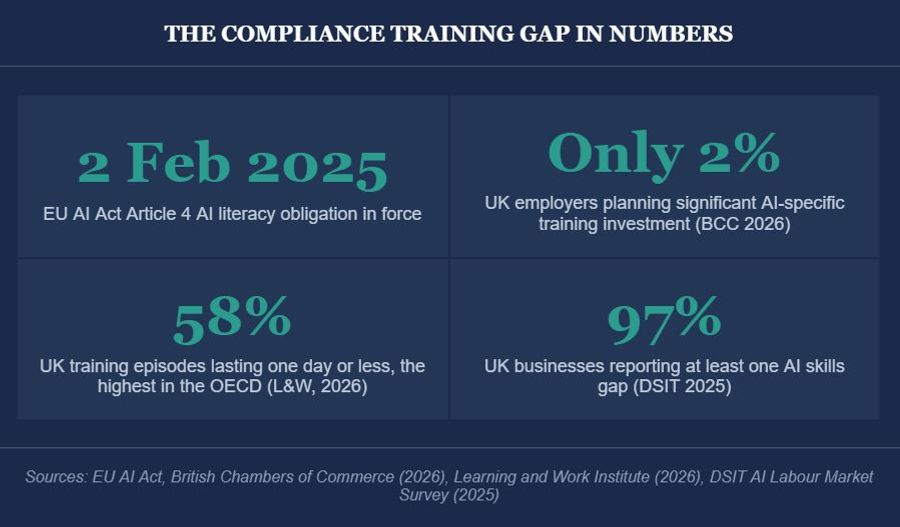
Three separate regulatory clocks started ticking at almost the same time. EU AI Act Article 4 came into force on 2 February 2025, requiring every organisation that deploys AI systems to ensure its staff have a sufficient level of AI literacy. The RICS Responsible Use of AI standard became mandatory on 9 March 2026, demanding named-surveyor accountability for every AI-influenced output with a material impact. ISO 42001 certification, the world's first AI management system standard, requires demonstrable, documented compliance training of the people running the system. Three frameworks. Three sets of obligations. One sector that is, on current evidence, badly underprepared.
This is why the AI compliance training market in UK construction, property, and facilities management is about to break. Not gently. The combination of regulatory deadlines, professional body requirements, and an industry-wide skills gap means that firms that have been getting by with a one-hour e-module and a certificate will find that approach no longer good enough.
What the regulations actually require
EU AI Act Article 4 places a direct obligation on AI deployers, and that includes any built environment firm using AI tools for cost estimation, planning analysis, contract management, or building performance modelling. The obligation is high-level: ensure your staff "have a sufficient level of AI literacy", taking into account their technical knowledge, experience, education, and training. There is no prescribed number of hours, no single approved course. That flexibility sounds helpful. It is actually a compliance trap. Without clear internal standards, firms cannot demonstrate they have met the obligation. According to Latham & Watkins, evidence of compliance and documentation of training measures will be scrutinised in any later regulatory investigation. The absence of records is itself the problem.
The RICS standard adds a further layer. It requires named individual accountability for every AI-influenced output that materially affects surveying services. Not because RICS wants to blame individuals, but because named accountability creates explainability. Someone must be able to explain the decision if challenged. That person needs the knowledge, skills, and experience to assess output reliability. That is, by any definition, a competence requirement. The standard explicitly acknowledges that RICS is not asking members to become computer scientists, but it is asking them to understand AI well enough to make properly informed professional judgements about the tools they use. That requires compliance training with genuine substance.
RICS also updated its CPD framework from January 2026. Members now face mandatory structured CPD covering AI, data and technology at least once every three years, alongside ethics and sustainability. That means a minimum 20 hours of CPD per year, of which 10 must be structured. According to RICS, the AI topic must be covered in a structured learning format of at least one hour. Given that the Responsible Use of AI standard is now in force, "AI, data and technology" CPD will need to engage with real governance and accountability questions, not just a glossy overview of what machine learning is.
The CPD landscape: what RICS, CIOB, CITB, and IWFM are doing
Across the built environment, professional bodies are updating their compliance and training frameworks at different speeds. RICS has moved the fastest. Its revised CPD rules, mandatory from January 2026, make AI a stipulated topic. The RICS Responsible Use of AI standard provides supporting materials, sector-specific case studies, and a FAQs document to help members implement the framework in practice, but it stops short of prescribing particular compliance training courses. That leaves individual members and regulated firms to source appropriate structured CPD themselves.
CIOB offers a Construction Ethics and Compliance course through its Academy, covering professional standards, ethical decision-making, and regulatory obligations. Its free FutureLearn course on construction ethics and compliance has been available since 2020. Neither course yet has an explicit AI literacy module at the time of writing. That is a gap CIOB will need to address as AI governance obligations land on its members. Ethics and compliance training for construction professionals that ignores AI is now incomplete by definition.
CITB's Industry Picture 2026, published in February, is frank about the state of the sector: the industry needs an additional 48,000 workers per year just to meet current demand, rising to 160,000 per year if housing and retrofit targets are included. The report identifies modernising training and making better use of modern technologies as core priorities. Crucially, the CITB framing is about workforce capacity. It does not yet address AI regulatory training obligations as a distinct need. That is a gap that training providers, employers, and CITB itself will need to close.
IWFM (Institute of Workplace and Facilities Management) runs live online facilities management training through its Academy, all of which contributes to CPD and aligns with IWFM Professional Standards. BIFM merged with IWFM in 2018, so the combined body represents a wide FM workforce now using AI tools for space management, energy monitoring, and predictive maintenance. Compliance and training obligations under both the EU AI Act Article 4 and the RICS standard apply to FM professionals working in surveying-adjacent roles. They need compliance training that is mapped to their actual risk exposure, not a generic corporate e-learning module.

Online CPD modules count towards structured learning hours, but only if the content has real depth.
ISO 42001 and the certification demand
For larger firms pursuing ISO 42001 certification, increasingly demanded in procurement and by institutional clients, the compliance training requirement is explicit. The standard requires a functioning AI management system, which means documented training, internal auditor competence, and ongoing monitoring. BSI Group offers ISO 42001 training from introductory awareness to Lead Auditor level, delivered live online, in person, or self-paced. Intertek runs a three-day Lead Implementer course covering AI governance, risk and impact assessment, and audit preparation. LRQA offers both certification and supporting compliance training courses for organisations building ISO 42001-aligned AI management systems.
These are substantive courses. The BSI Lead Auditor programme takes experienced ISO auditors and applies the AI management system framework to their existing competence. That is not the same as a one-hour module. For built environment firms pursuing ISO 42001, compliance training is not a tick-box exercise. It is an ongoing investment in documented staff competence. The certification bodies will check.
"We have a huge gap not just now in terms of AI skills but also this gap is expected to continue in the future because at the moment, our curriculum, in schools and universities doesn't have anything on AI." FE digital learning lead, cited in GOV.UK AI Skills for the UK Workforce, 2025
The box-ticking problem
The uncomfortable context for all this regulation is that UK employers are already bad at training in general. A Learning and Work Institute report published in March 2026 found that employer investment in skills has fallen 30% per employee compared with 2011 and 36% per employee since 2005. More than half of UK training episodes last a single day or less, the highest proportion in the OECD. UK employees report receiving less than one hour of training per month, less than half the figure in South Korea and Switzerland. The primary focus of training for 19% of UK employees is health, safety, and security, the largest single category. The report identifies an over-reliance on mandatory tick-box training, crowding out deeper upskilling.
The irony is stark. The sector needs better compliance training now, but the culture of treating compliance training as a box-ticking exercise has produced a workforce that has learned to race through mandatory modules for a certificate rather than actually changing behaviour. A 30-minute AI awareness click-through will not satisfy Article 4. It will not satisfy an RICS audit. It will not satisfy an ISO 42001 assessor. What regulators, professional bodies, and certification bodies are asking for is evidence of genuine competence development: role-specific learning, applied scenarios, documented assessment, and a record of what has changed.
Good compliance training courses distinguish themselves on a few clear criteria. First, they are mapped to specific regulatory obligations, not "AI awareness" in the abstract, but Article 4 of the EU AI Act or RICS standard section four. Second, they are role-specific. A quantity surveyor using AI for cost planning needs compliance training that addresses hallucination risk in estimating outputs and named-accountability obligations. A facilities manager using AI for energy optimisation needs training on data governance and system performance monitoring. Generic content serves neither. Third, good ethics and compliance training includes applied scenarios. Regulators and professional bodies are not looking for quiz completion; they are looking for demonstrated capacity to make better professional decisions. Fourth, it generates documented evidence: a record that can be presented in a CPD audit, a regulatory investigation, or a client's due diligence process.
Three things to do now
One. Map your AI tools to the RICS Responsible Use of AI standard and EU AI Act Article 4. List every AI system your firm uses that could have a material impact on professional outputs. For each one, identify who in your team needs compliance training, and at what depth. Not everyone needs a Lead Auditor course. But everyone using an AI tool in a professional context needs something more than a one-hour module.
Two. Build compliance and training into your 2026 CPD cycle now. RICS members must record structured CPD on AI, data and technology in the current three-year window. Log it by 31 January 2027 for 2026 activity. CIOB, IWFM, and CIOB members: check your body's mandatory CPD topics, as they are updating. If there is no relevant structured course on your body's CPD platform yet, BSI, Intertek, and LRQA all offer compliance training courses that are structured, assessable, and certifiable.
Three. Separate ethics and compliance training from tick-box compliance. Write a short internal brief that explains to your team not just what the training covers, but why it matters for them specifically. Name the regulatory obligations. Explain what named accountability means in practice. Show people the RICS standard section on output reliability and hallucination risk. When people understand the reason for the training, retention improves, and that is what regulators will be asking about when they investigate whether a firm's AI literacy measures were adequate.
The window for getting ahead of this is shorter than it looks. The RICS standard is already in force. Article 4 has been in force since February 2025. ISO 42001 auditors are already being trained. The market for genuine, substantive AI compliance training in the UK built environment is about to accelerate fast. The firms that start now will be in a much better position than those that wait for the first professional conduct inquiry to arrive.
The Responsible with AI programme helps architects, designers, and other built environment professionals develop practical frameworks for integrating AI tools responsibly.


