

A cleaning robot detects a spill, cordons off the area, completes the clean, and updates the work order system. No human touched it. That is not a demo from a trade show floor. That is Mitie's description of where agentic AI in facilities management is heading right now, published in February 2026. If you work in built environment services and have not yet thought through what this means for your team, your contracts, or your liability, this is a good moment to start.
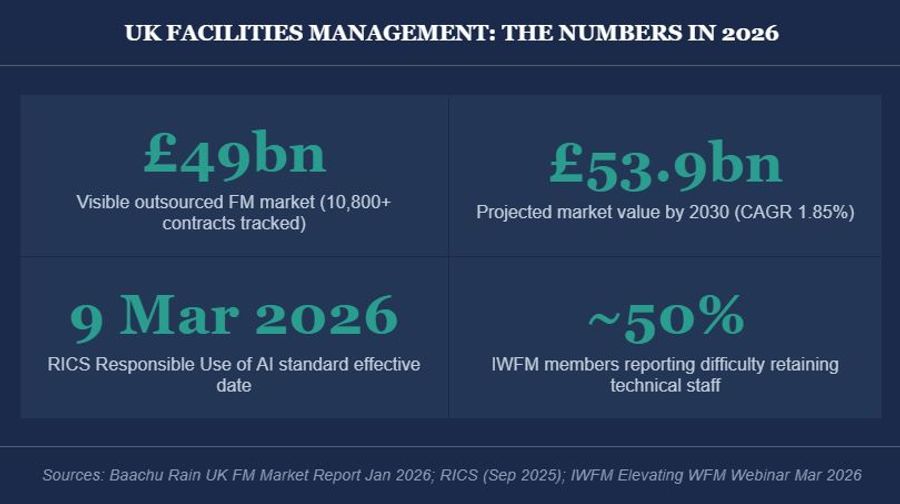
Facilities management in the UK is a £49 billion outsourced market, according to Baachu Rain's January 2026 report, which tracks over 10,800 live contracts across the public and private sectors. The sector is projected to grow to £53.9 billion by 2030 at a CAGR of 1.85%. That sounds measured. But underneath those numbers, the operational model for facilities management is changing faster than the contract values suggest.
What is facilities management in 2026?
If someone asks you what facilities management is, the textbook answer is used to cover building maintenance, cleaning, catering, security, and space allocation. That is still the core. But in 2026, the answer has to include the data layer. Facilities management now means managing the physical estate and the digital infrastructure that monitors, predicts, and increasingly automates how that estate operates. What is facilities management in the AI era, practically speaking? It is the discipline that sits between the building and the organisation, deciding what the data means and what to do about it. The building itself has become a sensor-dense system producing occupancy data, energy readings, air quality metrics, and asset performance signals, all feeding into software platforms that can act on them without waiting for a human to notice a problem.
The IWFM's March 2026 webinar, Elevating Workplace and Facilities Management in 2026, framed it plainly: UK organisations are entering 2026 facing intensified regulatory scrutiny, ongoing budget pressure, accelerating digital transformation, and a widening skills gap. The IWFM's own data showed that almost half of respondents find it difficult or very difficult to retain staff with the technical skills their organisation requires. That is not a new problem. What is new is that AI tools are starting to fill some of those gaps, which creates a different set of questions about oversight, competence, and accountability.
The big operators and what they are actually doing with AI
The largest facilities management companies UK clients use every day are moving from AI pilots to deployment at scale. Mitie, which describes itself as running one of the UK's largest and most diverse fleets of service robots, has cleaning co-bots operating across airports and retail sites, drones conducting building fabric inspections, and autonomous systems working in security and engineering environments. Andy Oldroyd, Mitie's Emerging Technology Lead, has written that the next phase is agentic AI, which introduces a decision-making capability that allows systems to interpret goals, break complex objectives into steps, and adapt plans in real time. The operational implication is significant: FM will move from simple, pre-defined task automation towards more autonomous operation, with multi-step activities completed independently and less human involvement in routine execution.
Sodexo expanded its technology capabilities in October 2025, acquiring a specialist in smart building technologies to bolster its IoT and integrated FM offering, according to market research cited by Market Research Future. ISS, CBRE, OCS, and JLL Workdyne are all named in the same competitive field. Among the top 20 facilities management companies UK collectively account for 36% of total contract value by Baachu Rain's data. The rest of the market is fragmented, which means smaller providers face more pressure to demonstrate data capability and technology integration when tendering.
CAFM, IWMS, and the role of the building management system
Much of the AI capability in facilities management today runs through three integrated platforms: CAFM (Computer-Aided Facility Management), IWMS (Integrated Workplace Management System), and BMS (Building Management System). Understanding how they connect matters for anyone in the sector.
CAFM handles day-to-day operations: maintenance scheduling, compliance tracking, work order management, and asset records. IWMS adds the strategic layer, covering lease accounting, portfolio analytics, space utilisation, and sustainability reporting. The BMS controls the physical building, including heating, lighting, ventilation, and access. When these three work together, a fault detected by the BMS can automatically trigger a work order in the CAFM, while the IWMS tracks its impact on space and energy performance. That is the integrated picture. As Kevin Gilhooly, Interim Healthcare Solutions Lead at MRI Software, put it: "It's about connecting operational data with strategic insight."

A building management system control room: the integration of BMS, CAFM, and IWMS platforms is now considered essential infrastructure for modern facilities management.
AI sits on top of all three. Predictive maintenance tools use real-time and historical asset data to forecast when servicing will be needed, before equipment fails. IoT sensors feed occupancy data into automated HVAC and lighting controls, reducing energy use without anyone adjusting a thermostat. AI chatbots assist visitors and field technicians. And walking inspection robots, now being trialled in several UK estates, combine image recognition with live CAFM integration. The maintworld.com analysis from March 2026 is direct: the integration of CAFM with IoT, BIM, and AI is no longer a competitive advantage, it is a necessity for sustainable building operation.
"For NHS Trusts aiming to modernise their estates, integrating CAFM, IWMS and BMS platforms is no longer optional, it's essential." Kevin Gilhooly, Interim Healthcare Solutions Lead, MRI Software
The role of facility manager is not disappearing. It is getting harder.
There is a recurring debate about whether AI will reduce headcount in FM. The more accurate picture is that the role of facility manager is shifting from manual execution to data interpretation and system oversight. Johnson Controls' headquarters in Milwaukee offers an instructive example: fifteen years ago, the facility required 25 full-time maintenance staff; today, two people manage multiple LEED Platinum buildings equipped with AI-driven smart systems. That is not a UK example, but the trajectory is visible in UK contracts too, where larger operators are deploying fewer operatives on routine tasks while adding data analysts and technology managers.
The IWFM's 2026 skills analysis is clear that the role of facility manager in this environment requires new competencies. Technical proficiency remains the biggest skills gap. But leadership, data literacy, and the ability to oversee AI-generated outputs are now equally important. Knowing when to trust an AI recommendation and when to override it is itself a professional skill. The IWFM webinar in March 2026 described this as a sector where FM has shifted decisively from a support function to a strategic driver of organisational resilience and compliance.
The practical shape of the role of facility manager in 2026 looks something like this: less time on reactive callouts, more time reading dashboards; less manual scheduling, more reviewing AI-generated maintenance programmes; less filling in paper forms, more querying the CAFM with natural language. The administrative reduction is real. But it comes with greater accountability for the decisions that AI surfaces, because when a system makes a wrong call on a safety-critical asset, the facility manager is still the named professional responsible.
The regulatory floor: RICS and ISO 42001
UK built environment professionals now have a formal regulatory baseline for AI use. The RICS Responsible Use of AI standard came into effect on 9 March 2026, having been published in September 2025. It applies to RICS members and regulated firms worldwide and sets mandatory requirements alongside best practice expectations. The RICS standard covers data governance, AI procurement and due diligence, output reliability and assurance, and client communication. Surveyors must tell clients in writing when and how AI will be used, and must apply professional judgement to assess whether AI output has materially affected service delivery. This matters directly for facilities management companies UK where RICS-qualified surveyors sit on the FM team or are named as responsible professionals.
As Maureen Ehrenberg, RICS Acting President Elect, put it at the standard's launch: "This standard ensures surveyors remain at the forefront of innovation while protecting clients, data, and public trust." The standard is not asking practitioners to become computer scientists. It is asking them to be accountable for the AI tools they use on client work.
ISO 42001, the international standard for AI management systems, sits alongside the RICS standard as a governance framework for organisations rather than individual practitioners. It requires structured policies, AI risk registers, human-in-the-loop controls for critical decisions, and oversight of third-party AI vendors. For a large FM operator deploying predictive maintenance tools across hundreds of sites, ISO 42001 provides the audit-ready framework to demonstrate that AI use is controlled and traceable. Facilities management firms that ignore both standards are taking on contractual and reputational risk they may not have priced into their tenders.
Three things to do now
One. Audit your current software stack. If your CAFM, IWMS, and BMS are running as separate systems with no integration, you are generating data that is not reaching the people or processes that could act on it. The MRI Software 2026 trends analysis is direct: mobile-first tools, AI-powered maintenance, and smart building integrations are fast becoming industry standards, not nice-to-haves. If your facilities management operation is still running on disconnected systems, integration is the first investment to make.
Two. Map the AI you are already using. Many facilities management teams are using AI features they did not knowingly procure because vendors have embedded them into existing CAFM and scheduling tools. The RICS standard requires you to identify where AI has a material impact on service delivery and document it. Run through your software contracts, identify which tools include AI or ML components, and decide whether your current oversight process is adequate for each one.
Three. Build the skills bridge now. The IWFM's data shows that nearly half of organisations struggle to retain technical FM staff. AI tools can absorb some routine workload, but they also require a new kind of competency to manage. Invest in training your team on data literacy, AI output validation, and the basics of responsible AI use under the RICS standard and ISO 42001. The facilities management companies in the UK that win the next round of contracts will be the ones that can demonstrate both operational AI capability and governance maturity.
The building has always been a complex system to manage. Now it generates more data, makes more autonomous decisions, and sits inside a regulatory framework that expects professionals to stay in control of it. That is a harder job than it was five years ago. It is also done well, a more valuable one.
The Responsible with AI programme helps architects, designers, and other built environment professionals develop practical frameworks for integrating AI tools responsibly.


