

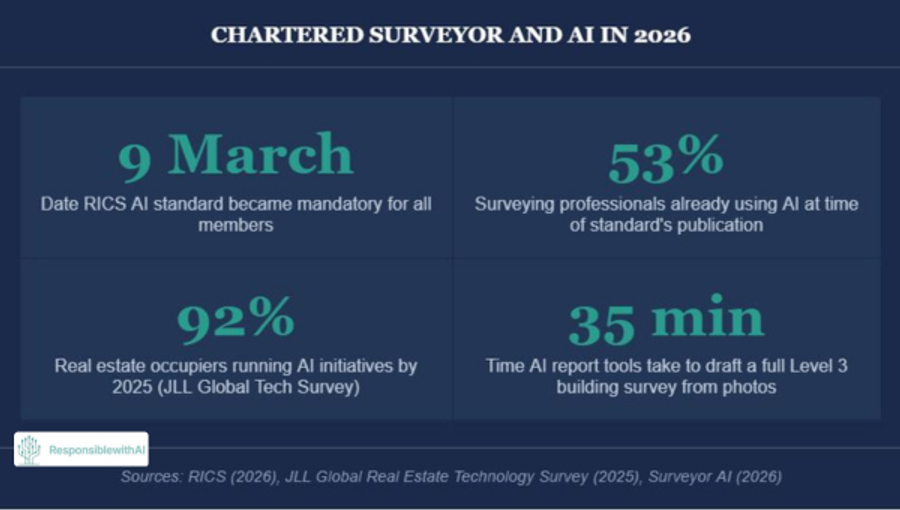
On 9 March 2026, a new mandatory standard came into force for every RICS member in the UK and globally. The RICS Responsible Use of Artificial Intelligence in Surveying Practice standard does not ask whether a chartered surveyor uses AI. It assumes that AI is already in the workflow, and sets out, in detail, exactly how it must be governed. Whether you work in residential survey, building survey, valuation, party wall matters, or dispute resolution, compliance is not optional.
This is not a guidance note or a best-practice document. It is a professional standard, meaning it will be taken into account in regulatory, disciplinary, and legal proceedings. For any chartered surveyor using AI tools that have a material impact on the delivery of surveying services, the obligations are clear: written risk registers, due diligence on AI suppliers, disclosure to clients, and a named qualified professional taking accountability for every output. The standard applies to firms of all sizes, from global players like Savills and JLL down to the sole practitioner preparing a Home Buyer Report for a first-time buyer in Norwich.
What Is a Chartered Surveyor and Why Does AI Change the Role?
What is a chartered surveyor? In plain terms, it is a qualified property professional who has passed the RICS Assessment of Professional Competence and holds MRICS or FRICS designation. A chartered surveyor can work across residential survey, commercial valuation, building pathology, project management, party wall matters, planning, and land. The designation carries legal weight. Mortgage lenders, courts, and insurers rely on the professional judgement attached to it. That professional judgement is exactly what the new AI standard is designed to protect.
AI tools are now embedded in the day-to-day practice of a chartered surveyor across the UK, often quietly. Automated valuation models sit inside the data feeds that valuers reference. Microsoft Copilot drafts correspondence. AI-assisted report generators such as Surveyor AI turn site photographs into structured draft Level 2 and Level 3 building survey reports in under 35 minutes. According to the RICS consultation data, at the time the standard was published, 53% of surveying professionals were already using AI tools, most commonly ChatGPT or Copilot, while 36% had not yet adopted any AI at all. The profession is not waiting for permission. The question is whether it is doing so responsibly.
Residential Survey and Building Survey: Where AI Is Being Used Now
In the residential market, the most visible AI application is report drafting. A chartered surveyor conducting a Level 2 Home Buyer Survey or a Level 3 building survey still carries out the physical site inspection in full. But the time spent writing up condition ratings, defect descriptions, and repair recommendations has traditionally matched or exceeded time on site. AI tools now generate a structured draft from annotated photographs, cutting that drafting time significantly. The surveyor reviews, corrects, and signs off, which is exactly what the RICS standard requires. All formal professional outputs must be reviewed and approved by a named RICS-qualified surveyor who accepts full professional responsibility.
Firms like Peter Barry Chartered Surveyors, which updated its AI use policy on the day the standard came into force in March 2026, illustrate the approach many practices are taking. They use Claude AI and Microsoft Copilot within a controlled Microsoft 365 environment for drafting correspondence and documents, with explicit governance: AI does not make professional decisions or sign off work. That kind of published AI policy, once rare, is fast becoming standard practice for a compliant chartered surveyor firm.
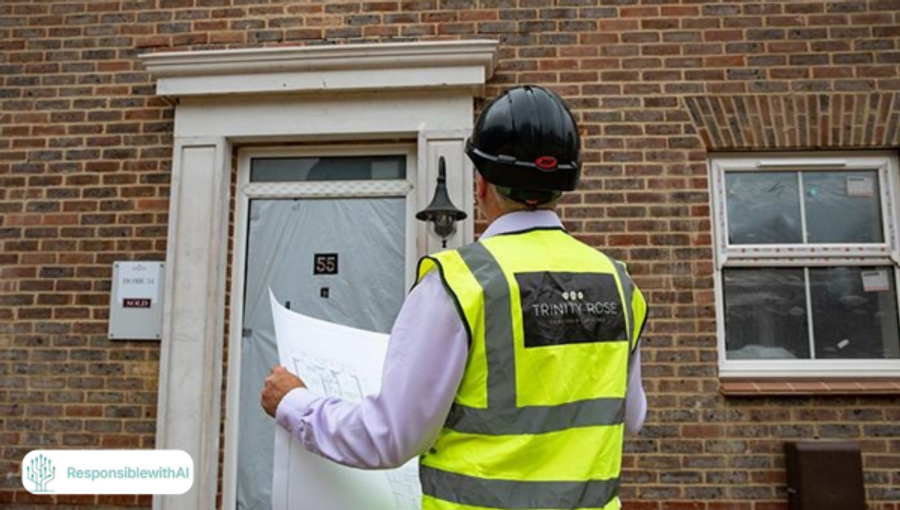
Residential survey work remains firmly human-led, but AI is changing how quickly a chartered surveyor can turn a site visit into a finished report.
Valuation: AVMs, Hybrid Models, and the Human Override
Automated valuation models have been in use at major firms for years. Savills, Knight Frank, JLL, CBRE, Cluttons, and Carter Jonas all use data analytics and machine learning tools within their research and advisory functions. According to Savills, technology ranked as the second most important driver shaping global real estate in 2026, propelled by rapid AI adoption. JLL's own AI platform, JLL Falcon, is described as the first AI platform purpose-built for commercial real estate, turning complex data into actionable insights for the firm's valuers and advisers.
For a chartered surveyor working on residential or commercial valuation, the critical distinction is between an AVM as a reference tool and an AVM as the output. The RICS standard is unambiguous: where AI output has a material impact on a valuation, the surveyor must assess and document the reliability of that output in writing. A named, appropriately qualified surveyor must be identified. The client must be informed in advance. The standard's explainability clause requires that, on request, any surveyor must be able to provide a written account of the AI tools used, the due diligence conducted, and the reliability decisions made. The computer saying it is correct is not enough.
The gap in accuracy between AI and professional assessment remains significant for complex stock. According to data from Lendlord's analysis of UK AI valuation tools, AI valuation accuracy for standard terraced houses runs at around 92% compared to 97% for a professional surveyor, but for period properties the gap widens to 76% versus 93%, and for unique or bespoke stock the divergence is even greater. These accuracy gaps are precisely where the professional judgement of a qualified surveyor remains irreplaceable.
"I do worry about automation bias, the view that it must be true because the computer says it's true. The standard helps here as it talks about professional scepticism. This highlights the importance of the Chartered Surveyor in curating the inputs and validating the outputs." Paul Beeston FRICS, RICS Practitioner Panel
Party Wall and Dispute Resolution: A Quieter Adoption
Party wall work has seen a quieter but genuine AI adoption. The administrative burden of party wall practice is substantial: drafting notices, preparing schedules of condition, producing awards, and managing correspondence between building owners, adjoining owners, and third surveyors. AI tools are being used to draft standard-form notices and first-pass award text, which a chartered surveyor acting under the Party Wall etc. Act 1996 then reviews and amends.
RICS launched a consultation in April 2026 on the draft 8th edition of Party Wall Legislation and Procedure, running through May 2026. The updated guidance places renewed emphasis on competence and consistency, and strengthens conduct guidance, including fee practices. The standard's requirement that a party wall surveyor's appointment is personal and statutory, independent of client instruction, means that any AI-assisted output in a party wall award is squarely the responsibility of the named chartered surveyor who signs it off. AI speeds up the drafting. Accountability stays with the professional.
PI Insurance: The Coverage Question Every Firm Needs to Answer
Professional indemnity insurance is a live concern wherever AI is used in surveying practice. The RICS standard addresses this directly. RICS confirms that the minimum PI wording does not exclude the use of AI in support of normal business practice, so a chartered surveyor using AI tools as part of standard service delivery should be covered under existing PI arrangements. However, firms developing and selling AI tools are on different ground; RICS advises those firms to notify their insurer, obtain approval, and request that the definition of Professional Services is amended accordingly.
PI insurers are already asking sharper questions. According to Browne Jacobson's February 2026 analysis, insurers are now probing clients on whether AI is being used for high-risk functions such as decision support for professional advice, what governance and human oversight is in place, and how AI-generated valuations are validated against comparable market data and professional judgement. CFC's January 2026 PI trend report is blunt: if an AI tool produces incorrect outputs, liability typically falls on the professional service firm, not the technology provider. Without explicit coverage, contractual vulnerabilities could lead to costly claims.
For a sole-practitioner chartered surveyor or a small firm, the practical message is this. Review your terms of engagement now. Add clear language about when and how AI is used, what clients can do to contest that use, and what indemnity cover applies. The RICS standard requires this as a minimum. Your PI insurer may require it as a condition of cover.
What the RICS Standard Actually Requires: A Practical Summary
The RICS Responsible Use of AI standard is 22 pages of conduct requirements. For the working chartered surveyor, four obligations matter most. First, a written risk register covering AI systems that have a material impact on service delivery, reviewed at least quarterly. Second, written due diligence before procuring any third-party AI tool, covering data quality, bias risks, environmental impact, and supplier liability. Third, a named qualified professional who assesses and documents the reliability of AI outputs. Fourth, upfront written client disclosure wherever AI will have a material impact on the advice given.
The standard also addresses hallucinations and bias directly, requiring that every chartered surveyor using AI tools maintains a basic understanding of how those tools can fail. The risks of AI hallucinations, where AI produces confident but incorrect outputs, are of particular concern in valuation and building survey, where a missed defect or an incorrect comparable sale could expose both the client and the professional to significant loss. Quality assurance through randomised dip-sampling of AI outputs is a requirement for high-volume or automated workflows.
How to Become a Surveyor in an AI World
If you are currently exploring how to become a surveyor, the AI agenda is already woven into the competency framework. RICS is developing training resources alongside the new standard, and AI literacy is fast becoming a baseline expectation in the APC. Understanding how automated valuation models work, how to prompt and quality-check an AI output, and how to explain AI-assisted advice to a client are skills that candidates are expected to develop. Nella Pang MRICS, principal at Omega RE, which manages around 70 UK properties, makes the commercial case plainly: AI levels the playing field for smaller practices, freeing the surveyor to spend time on strategic client advice rather than manual data compilation. If you are unsure what is a chartered surveyor in today's sense of the term, the answer now includes someone who can critically assess an AI output and explain it to a client in plain language.
The Chartered Land Surveyor and Wider Sector Applications
The AI conversation is not confined to residential and commercial property. A chartered land surveyor working on boundary disputes, compulsory purchase, or development land appraisals is equally subject to the RICS standard. AI tools are being used in land measurement, planning research, and environmental data analysis. The principle is the same wherever you work in the profession: the surveyor is accountable for the advice, regardless of how that advice was assembled. AI is a production tool, not a professional. That distinction matters in court and in front of a RICS Regulatory Tribunal. For those researching how to become a surveyor in a land or planning specialism, the same RICS standard applies: AI tools can support the analysis, but the chartered land surveyor is accountable for the output and the advice.
Three things to do now
One. Audit your AI tool use this week. List every AI-enabled system your practice uses that could materially affect a client deliverable: report drafting tools, AVMs, data analytics platforms, AI-assisted correspondence. Start your written risk register now. If you have not yet built one, the quarterly review requirement means you are already behind.
Two. Update your terms of engagement to include an AI disclosure section. Set out clearly which AI tools are used in which service lines, what clients can do to query or contest that use, and what indemnity cover applies. The RICS template client information note is a useful starting point.
Three. Call your PI insurer or broker before the end of the month. Confirm that your current policy wording covers AI-assisted professional work under the normal business practice clause. If you are developing or reselling AI tools, even an internal tool built on a third-party model, get explicit written confirmation from your insurer that those activities fall within your Professional Services definition.
The new RICS AI standard does not ask the chartered surveyor to become a data scientist. It asks for the same professional scepticism, accountability, and client transparency that have always defined good surveying practice. The tools are new. The standard is not.
The Responsible with AI programme helps architects, designers, and other built environment professionals develop practical frameworks for integrating AI tools responsibly.


