

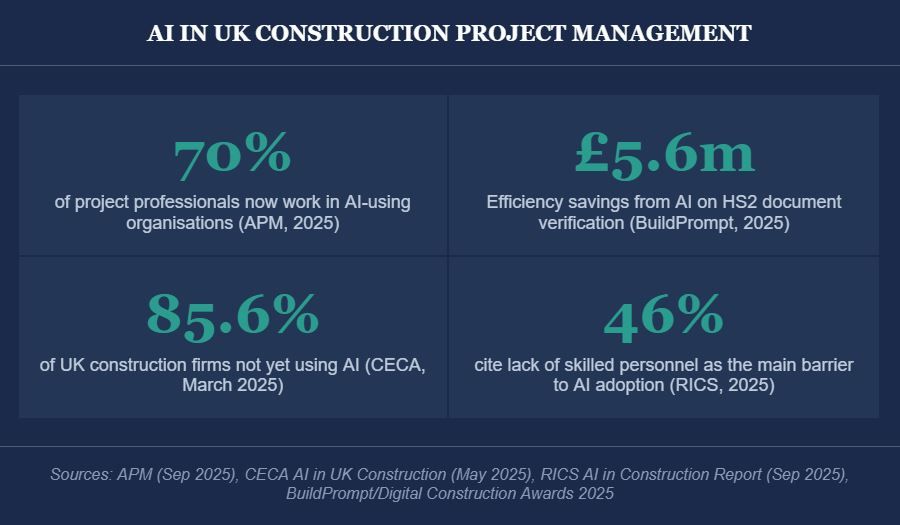
On HS2, a startup called BuildPrompt won Best Use of AI at the Digital Construction Awards 2025 for turning a two-week document review into a 35-second automated process, saving an estimated £5.6 million in efficiency costs. That is a genuine result on a genuine UK construction management project. It is also one data point. The question for anyone working in construction project management right now is not whether AI is arriving. It clearly is. The question is where it actually helps, where it falls flat, and what the role now has to do differently.
This article looks at that question directly, drawing on recent data from APM, RICS, CIOB, and the tools already running on UK sites. Whether you are mid-career and looking at construction management courses to sharpen your skills, or leading a team on a live project, the picture is both more promising and more complicated than the marketing suggests.
What the numbers say
According to the APM's September 2025 survey of 1,000 project professionals, 70% of organisations now use AI in their projects, up from 36% in 2023. That is almost doubling in two years. The three functions where project professionals report the clearest benefit from AI in construction project management are task and schedule automation, resource allocation, and risk analysis and forecasting, each cited by 50% of AI users.
The picture is not uniformly positive, though. The RICS AI in Construction report, published September 2025 and drawing on more than 2,200 professionals globally (nearly half of them UK-based), found that 45% of construction organisations have no AI implementation at all, and only around 12% are in regular use of AI in specific processes. Construction project management as a discipline sits at different levels of readiness across different firms and sectors, and that gap matters in a market where clients are increasingly expecting digital delivery evidence.
The CECA AI in UK Construction report, May 2025, painted a similar picture at sector level: 85.6% of UK construction businesses had not yet adopted AI in March 2025, compared to around 75% of businesses in other sectors. Construction is lagging the wider economy on adoption, even as pressure to catch up grows. That pressure is coming from clients, from procurers on major programmes, and increasingly from the professional bodies.
Where AI is working on UK construction projects
The clearest wins so far are in document-heavy, rule-bound processes at the edges of construction project management rather than its operational core. HS2 is the most visible example. The programme carries 37,983 requirements across 89 modules and 34 major contracts, and each verification and validation matrix runs to 800-plus rows. BuildPrompt's AI handled compliance checking that previously consumed weeks of senior engineer time. The scale of the problem made the AI's advantage decisive, and it won the judges' recognition precisely because the measurable benefits were real and scalable.
On the tools side, Procore's Helix AI layer, announced at Groundbreak 2025, now offers an RFI Creation Agent that reduces information retrieval from days to seconds by searching across specs, submittals and building codes. Its Daily Log Agent automates jobsite reporting. These are genuine time savings on the administrative tasks that eat a construction project manager's week.
Autodesk Construction Cloud's Construction IQ has been used over five million times in the past year, according to Autodesk. It scans issues, checklists and observations to surface risk, flagging RFIs most likely to affect cost and schedule before they escalate. That early warning function is well matched to construction project management, where late identification of design clashes is one of the most common causes of programme slippage.
ALICE Technologies uses AI to model construction scenarios and generate optimised programmes. ALICE's 2025 review described a case where a contractor facing liquidated damages used the platform to model recovery scenarios and saved 27 calendar days, protecting 2.7% of total project value. For large infrastructure construction project management programmes, that kind of scenario modelling gives planners options that manual re-sequencing would take weeks to generate.
Where it fails
The failures in AI-assisted construction project management tend to cluster around two things: data quality and misplaced trust.
AI tools need clean, consistent data. UK projects, especially in the SME sector, often run on a mixture of spreadsheets, WhatsApp messages, paper drawings and fragmented software. When data is poor, AI output is worse than useless because it looks authoritative. An AI-generated programme that confidently misallocates resources based on incomplete site data will waste more time than it saves. The RICS report identified poor data quality as the third most common barrier to AI adoption, cited by 30% of respondents.
The second failure mode is over-reliance. The CECA report is direct on this: "AI does not replace the need for human involvement in decision-making and should not lead to the development of over-confidence about the safety that systems provide." On a construction management project, the consequences of deferring too much to an AI recommendation can be serious. A schedule that looks optimal in the model may not account for the subcontractor stretched across three sites, or the procurement lead time that only an experienced commercial manager knows about.
James Doherty, a project controls expert at maritime consulting firm BMT, put it clearly in the APM survey: "You have to feel suitably qualified and experienced before you should be using AI to generate any work for you. It's about assurance. You have to sign your name at the bottom of anything you're delivering."
"You have to feel suitably qualified and experienced before you should be using AI to generate any work for you. It's about assurance — you have to sign your name at the bottom of anything you're delivering." James Doherty, Project Controls Expert, BMT
What governance the role now needs
Good construction project management has always required the ability to challenge outputs and hold the line on quality and safety. AI makes that responsibility more explicit, not less. The EU AI Act, now in force, designates certain AI systems in the built environment as high-risk, with conformity assessment requirements before deployment. UK construction organisations operating with EU clients need to pay attention. The August 2026 enforcement deadline for high-risk AI systems is approaching.
ISO 42001, the international standard for AI management systems, provides a practical governance framework for any organisation deploying AI in construction project management. It requires organisations to document AI decision-making, run bias and accuracy testing, and put human oversight controls in place. For those running projects, this matters at the firm level and at the individual accountability level. BSI is the first UK certification body accredited by UKAS to certify to this standard. For construction organisations already holding ISO 27001, the transition is relatively efficient, with significant structural overlap between the two frameworks.
For the individual construction project manager, governance means being able to answer four questions about any AI tool on the project: What data was it trained on? What does it not know? Who is accountable when it is wrong? And has it been tested on construction project management programmes like mine? If the vendor cannot answer those questions clearly, that is a governance gap, and the risk sits with the person who signs off on the output.
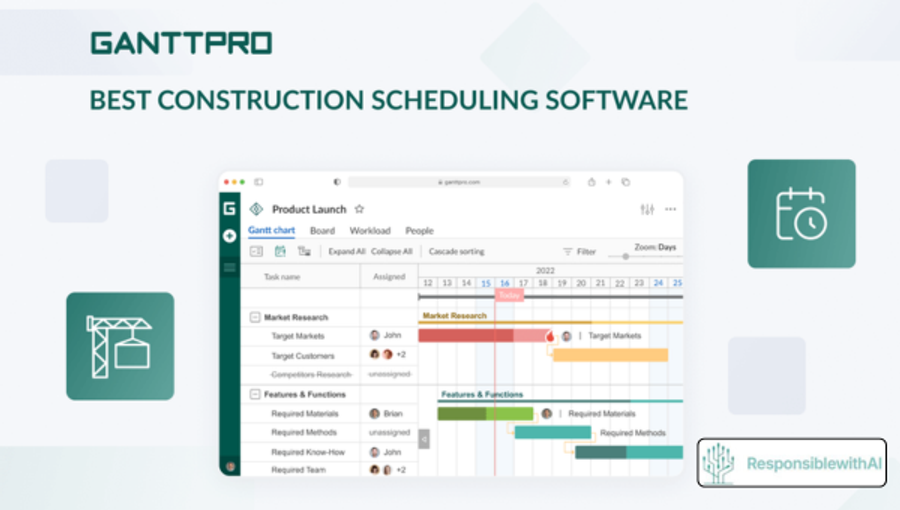
AI scheduling tools generate optimised programmes from complex constraints, but experienced construction project managers still need to validate outputs against site realities.
What construction project manager training needs to cover in 2026
The professional bodies are responding. 70% of project professionals feel their organisation is adequately preparing them for AI, according to the APM survey. The RICS Academy Certificate in Construction Project Management (£1,584, next cohort June 2026) covers digital tools and AI-adjacent competencies across its seven modules. The CIOB Academy Professional Certificate in Construction Project Management (£539) is structured around the CIOB Code of Practice and addresses modern tools. Both programmes are well-regarded starting points for construction management courses aimed at practitioners.
But construction project manager training in 2026 needs to go further than tool familiarity. The CECA report recommends role-specific AI training and inclusion of AI in professional development as explicit outcomes, not optional extras. The RICS report recommends that competency frameworks be updated to integrate AI considerations. Effective construction management courses should now cover how AI outputs can hallucinate or misrepresent data, how to stress-test AI-generated schedules and cost plans, and basic data governance relevant to the tools in use on any given construction project management programme.
The Connected Places Catapult reported in September 2025 that large infrastructure programmes such as HS2 are acting as testbeds for AI and digital construction delivery, and that the sector needs to do better at sharing what it learns. The Lower Thames Crossing and Sizewell C are expected to continue that pattern. The applied knowledge being built on these programmes is precisely what future construction management courses need to incorporate. At the moment, the gap between what is happening on a Tier 1 infrastructure construction project management programme and what a standard construction project manager training programme covers is substantial.
Three things to do now
One. Before deploying any AI tool on a construction management project, run a data audit. If your project data lives across five systems with no common data environment, fix that first. AI compounds data problems rather than solving them.
Two. If you are responsible for construction project manager training in your organisation, add at least one session on AI output validation. The key skill is not how to use the tool. It is how to catch the tool when it is wrong, and how to demonstrate you checked.
Three. Look at your contracts. AI-generated schedules, risk registers and RFI responses are increasingly ending up in contract documentation. If your standard terms do not address liability for AI-assisted outputs on a construction management project, they need to.
Construction project management has always been about making sound decisions with incomplete information under time pressure. AI does not change that. It changes the information landscape you are working in. The person who understands both the tools and their limits will be considerably better placed than the one who either ignores them or trusts them unconditionally.
The Responsible with AI programme helps architects, designers, and other built environment professionals develop practical frameworks for integrating AI tools responsibly.


